Categories
Assignments

All That Bad

I know I have warned against technology and all that the Internet has to offer, but I wanted to highlight some options where technology is more protective and beneficial than harmful. Smartphones specifically give us the ability to be connected unlike ever before. Moreso, new apps are being created every day to help promote healthy behaviors and provide the means to be more educated about one’s own health.

The App Store is an application that comes downloaded on all Iphones. If you search “postpartum depression,” there is only one option that appears. This app is called “Postpartum Hemorrhage,” and offers ACOG, or The American Congress of Obstetricians and Gynecologists, recommended safety checklists for management of postpartum hemorrhage. This app is made by Emgeesons Trading and Investment Co.(P.) Ltd and serves as a quick reference for Obstetric providers to assess and manage PPH.

The app offers information about each stage of PPH in addition to supplementary categories like ongoing risk, patient safety, risk calculator, and antenatal risk. Among these features, you have the ability to individualize the signs and symptoms that you or the patient is feeling.

The app is free, meant for IPhone or IPad, and based on the 5 reviews it has, it has five out of 5 stars and was commended for its usability and accessibility. It was recommended for healthcare providers as they are going through schooling and beyond, which is reflective of the more academic and informational schematic. After going through the app personally, I agree that this tool is most effective for someone who would be diagnosing and treating PPH rather than experiencing it.

Another app I was able to find was “MamaMend: Postpartum Health, by MamaMend.” This app is geared towards mothers who are in the postpartum period and is the only personalized childbirth recovery app for new moms that guides them through the ups and the downs of life after pregnancy. It is also free, has a 4/5 star rating, and is compatible on the IPhone/IPad/IPod touch Apple products.

This app is based off of 4 key words: Learn, Feel Confident, Research, and Find Answers. “Learn” has to do with understanding what is going on with your own body. The app provides articles and other reports of information that help explain certain symptoms of being postpartum like hair loss. Confidence is instilled by reading information created by experts and backed by science. The app offers a list of conditions like Baby Blues or Deep Vein Thrombosis where you can click to learn more. Research suggests finding out what is normal and what is not. The Internet is a great resource for definitions and reading materials that are meant to be accessed when you have questions. Lastly, find answers to what is going on with your body. Don’t be complacent and google “insomnia” if you can’t sleep at night or if you are having panic attacks.

This app is designed to help support moms and make them feel comfortable learning about what they don’t know and finding answers when something doesn’t feel right. It’s large library of information serves as a great tool to ensure you are not alone and that you are not questioning your health and recovery postpartum.

This last app is another great resource for keeping yourself healthy and active after pregnancy, so as to help a mom avoid having to go through PPH. Made by The SnapBack, The SnapBack app is free to download but there are in-app purchases to take this assistant’s capabilities to the next level. It is compatible with IPhone, IPad, and IPod touch.

This app has 4.8/5 stars with 29 ratings. A lot of moms wrote about how much they loved the user friendliness, layout, and sleek design. The long list of what The SnapBack has to offer includes and is certainly not limited to pelvic floor strengthening exercises for steady recovery, pill reminders, and weekly “what to expect” blurbs for both mom and baby.

This app helps keep moms aware of what is going on with their bodies and informed about what certain things might mean. It is a great tool to enhance education around postpartum problems and can help moms strengthen their bodies.

Overall, there are numerous resources in the App Store that provide information about PPH and prepare the mom via foods and exercise to prevent as much as possible. Looks like the Internet isn’t all that bad after all.

Categories
Assignments

The Frequent Killer: Fact or Fiction?

Gynecologists, midwives, and other researchers are very much so still in the infancy of their research into what is and what ought to be with respect to postpartum hemorrhaging. Looking at the literature, I’ve found, can actually be rather confusing because of the vast collection of conflicting information.

Long term studies, for example, have found high neonatal weight, perineal injury, and complications during birth to be associated with PPH. An article review however, claimed there to be strong evidence for 4 other specific causes including clotting defects, abnormal placental implantation and uterine atony, previous history of PPH, and genital tract trauma ie cervical tears. It also mentioned that caesarean section, multiparity, preterm birth, age, multiple gestation, epidural were more common causes where the evidence is more conflicting or weaker overall.

It is hard to assess what is real and what is truly a causal relationship when it comes to a complication like PPH because often times, everyone’s experience is different. Because PPH is such a frequent killer, data begins to pool and researchers are more capable of assessing trends. 

One of the biggest potential confounders in this situation is geographic location in the world. The culture of each country influences what they view as being a top priority and how they choose to address the issue. The country’s economic capabilities is another large part of the healthcare providers’ abilities to provide care.

Like any health problem that you can read about online, it is important to keep in mind that at the end of the day, your doctor knows you and your symptoms better than anything you will read on the internet. Should you decide to do some light reading via the Internet however, I encourage you to read a variety of articles. In doing so, you will gain a more whole view of PPH and become better educated.

Categories
Assignments

Real Life vs Online: How Different Are They?

What Double Tapping Says About You

What is homophily? I heard this word in a TEdTalk by Jennifer Golbek a couple of weeks back, and it is really resonating with me as I write this post. Homophily is defined as the connections one develops with people who are similar to them in some specific way. In Golbek’s video, she discusses how liking a curly fry page on Facebook is indicative of intelligence. 

Despite my excitement for now having a very convincing argument to eat more curly fries, I found the association rather odd. Golbek answered all of my questions as she explained that liking the page was not indicative of the content within it but rather the common attributes of the people who were a part of the page. But how could she relate the people who’d liked the page to intelligence?

This question leads me to my main goal here which is to warn and inform. Having a presence on social media gives these computer scientists the means to use your information. And while this is no reason to start freaking out (especially if you are pregnant, please stay calm), it is important to be mindful of what analysts can ascertain from just snidbits of information.

Why Should You Care?

As I mentioned in my previous posts, postpartum hemorrhage is a complication that can happen both during and up to 6 weeks after you have delivered your baby. The woman’s body experiences an excessive amount of bleeding which can result in maternal death if nothing is done about it. In fact, 125,000 women die every year due to postpartum hemorrhage, and 125,000 is 125,000 too many.

Joining groups on Facebook or following blogs are just a few ways for a woman and her support system to connect with people like her. You can follow my efforts to promote awareness about postpartum hemorrhage on Vimeo too. Going back to the idea of homophily, building this network of people who are like you is a benefit, but keep in mind that every group you are a part of and every page or post you like sheds light onto the online profile you are building each and every day about yourself.


Copyright Notice: The goal of this blog is strictly to inform and educate. There are billions of people living on this Earth, writing their own stories and concerned about what is happening in their own circle. This blog is meant to merge these worlds. All materials are original, unless credit is otherwise given.

Categories
Assignments

How Do You Know About PPH?

As I mentioned last week, postpartum hemorrhage is one of the most common problems for women during and after their birthing process, affecting 125,000 women in the US every year. PPH is a complication where the woman will lose deathly amounts of blood anywhere from right after their baby is born to a month after birth. In general, the information online about this topic is scholarly and educational, but one can never be too careful when using the internet.

The CDC, or Centers for Disease Control and Prevention, is a great place to start when you are looking for a trustworthy source of information. In this case, the CDC provides a page on pregnancy complications and the various obstetric procedures to control hemorrhages. The following graph shows the rate of PPH per 10,000 delivery hospitalizations from 1993 to 2014. 

This data is both a good source for qualitative evidence as well as informative knowledge for someone looking to further educate themselves on possible procedures that result from PPH.

University websites are consistently a great, reliable source for information. Stanford University has a page through Lucile Packard Children’s Hospital Stanford that answers a collection of useful PPH-related questions like “What are the symptoms of postpartum hemorrhage?” This family-centered hospital is nationally recognized for clinical excellence and California’s largest pediatric and obstetric health care network dedicated exclusively to children and expectant mothers. This website is best for expecting mothers or those who will be there to support the mom post-labor as it is informational, accurate, and could help save a life, should an unfortunate situation present itself.

The University of Texas Southwestern Medical Center published an article by Jamie Morgan, M.D., Obstetrics and Gynecology that was both informational and anecdotal. Dr. Morgan earned her medical degree from the UT Health Science Center at San Antonio and has since been certified by the American Board of Obstetrics and Gynecology in maternal-fetal medicine and published more than 20 scholarly articles.   

In this article, she opened with a brief about PPH and informed that some hospitals lack the proper skills and knowledge to manage this type of hemorrhaging. The bulk of her article was a personal story from one of her patients, Ashley Byrnes, about her experience with PPH.

As this article is both educational and emotional, it is ideal for someone looking to learn more about what PPH means and also gain exposure to a firsthand account. Dr. Morgan is clearly a credible source of information on such a topic, but when reading Ashley’s story, one must be careful and understand that this was her personal experience with PPH, and it can be different for everyone.

On that note, Annie Murray, a member of the Every Mother Counts blog community, shared her own story through this platform, which takes pride in sharing the information, perspectives, and stories that help make pregnancy and childbirth safe for every mother, everywhere. She described how she was close with her OBGYN and had had an easy first pregnancy before a traumatic second experience. This blog entry is a great primary source of information for a mom who may be experiencing the same symptoms or is looking to be proactive and learn about other women’s experiences. This medium is not ideal for someone in search of a description of PPH or factual/statistical evidence. 

Similarly, the MomsRising blog published Alia from White Plains, NY’s story. This blog promotes that is is where moms and people who love them go to change the world. Very similarly to Murray’s story, Alia wrote about her personal experience with PPH. These stories are valuable resources for those looking to really gain and understanding of how scary the process can be, but one must keep in mind that these are stories of these women’s personal experiences and therefore are not the most credible or reliable sources because every woman has their own story to tell. 

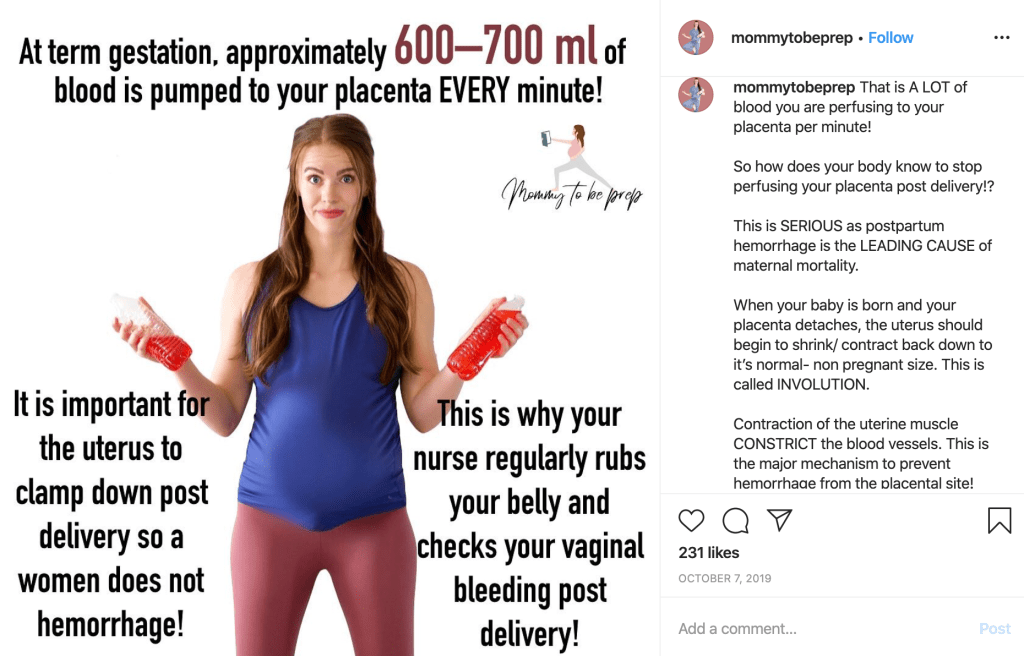
Another avenue of information that can deceiving is Instagram. This account, @mommytobeprep, is run by a woman who claims to be a mom, labor and delivery nurse, and an AFFA certified fitness instructor. Her posts are geared towards tips during pregnancy, and she often lists references from where she got her information. 

While these qualifications seem to make the information she is providing seem very credible, remember to take what you read online with a grain of salt, and to consult your doctor about any questions or concerns you may have or major changes that you are looking to make. This is a good first step but looking deeper to websites listed above like the CDC or Stanford to confirm these facts is crucial.

Overall, the information online about PPH is fairly simple to analyze. If you are reading about someone’s personal experience, keep in mind that that is their experience. Federal agencies like the CDC are always a great place to start when looking to do research into any health behavior or issue. University sources are also great resources for accurate information that you need not question.

As you read through blogs, posts on social media sites like Instagram or Pinterest with their graphics, remember to fact check and don’t believe it just because it looks pretty or sounds correct. And remember, when in doubt, your doctor is your friend!

Categories
Assignments

Postpartum Hemorrhage: What You Need to Know

If you are reading this, you are alive. And you are alive because a woman, your mother or not, had a successful pregnancy. Birth is a very common process as nearly 4 million people are born each year in the US, and yet, 2-3 women die every day from complications during birth.

One of the most common problems that can occur when bringing life into this world is hemorrhaging, affecting 2.9% of women in the US which translates to about 125,000. Postpartum hemorrhage as it is termed, is when a woman loses too much blood, resulting in insufficient blood flow throughout her body. Normally, after the baby has been delivered, the muscles in the woman’s womb contract, limiting the amount of blood loss once the placenta is detached. However, if these muscles do not contract, the woman is at risk of losing unsafe amounts of blood.

Drugs are doctor’s preferred method of prevention for blood loss. Before bleeding becomes a problem, women are given the option to take a drug to decrease the chances for excessive blood loss. Other drugs exist to help the muscles contract or to help the blood to clot. Their last resort option usually involves surgical techniques that include blocking the uterine artery or removing the uterus completely.

And yet, when we think of getting pregnant and having a baby, we tend to forget that any risk exists at all. But why would we?

And that’s the problem. Women give birth every day. Women are risking their lives every day. But no one is talking about these risks. Now, getting the conversation started is no easy task, I am aware. Rarely do I find myself at work talking about pregnancy, let alone talking about the gruesome details of childbirth. But the least we can do is be aware. Having the basic knowledge creates an atmosphere where women feel comfortable opening up and sharing their personal experiences. And if women feel accepted, the conversations can begin.

But why is it so important to talk about it? Why do we need these conversations to begin? If we never talk about something, it is hard to enact change. Ranked 47th in the world for maternal mortality, the US could use some change. More talk leads to more spotlight in the media which usually results in more funding to be allocated to solve the problem.

We cannot change overnight, but we need to do something because 125,000 deaths is 125,000 deaths too many.

Design a site like this with WordPress.com
Get started